/Ground%20Truth%20Agriculture/optimized/ground-truth-agriculture-hero-image.webp?width=1600&format=webp)
Ground Truth Agriculture
Giving a 100-year-old industry eyes it's never had
How do I know I'm not giving away grade?
Grain grading is one of the last manual processes in modern agriculture. A human looks at a sample, assesses colour, kernel shape, foreign material, and assigns a grade. It takes up to eight years to train a grader, and even then the best in the business are accurate about 80% of the time. Two graders can look at the same sample and reach different conclusions. The grade determines the price. The price determines the farmer's year.
Farmers have lived with this for generations. They bag a sample, send it away, and hope for the best. They never really know what they're leaving on the table, and there's no way to challenge a result that's based on one person's judgement against another's. The entire supply chain, from the combine to the terminal, runs on a process that hasn't fundamentally changed in over a century. Every other part of modern agriculture has been transformed by technology: GPS guidance, variable rate application, satellite imagery, precision seeding. But the moment that determines what the crop is actually worth still comes down to a person squinting at a handful of kernels.
Ground Truth Agriculture looked at that and saw the last untouched frontier. What if you could look inside the seed itself? Not with human eyes, but with sensors and machine learning capable of seeing what no grader ever could. Real-time, objective, consistent grading at every point in the supply chain. The farmer knows what they've got before the truck leaves the field. The buyer knows what they're getting before they make the deal. No subjectivity. No disputes. No value left on the table.
Farmers have lived with this for generations. They bag a sample, send it away, and hope for the best. They never really know what they're leaving on the table, and there's no way to challenge a result that's based on one person's judgement against another's. The entire supply chain, from the combine to the terminal, runs on a process that hasn't fundamentally changed in over a century. Every other part of modern agriculture has been transformed by technology: GPS guidance, variable rate application, satellite imagery, precision seeding. But the moment that determines what the crop is actually worth still comes down to a person squinting at a handful of kernels.
Ground Truth Agriculture looked at that and saw the last untouched frontier. What if you could look inside the seed itself? Not with human eyes, but with sensors and machine learning capable of seeing what no grader ever could. Real-time, objective, consistent grading at every point in the supply chain. The farmer knows what they've got before the truck leaves the field. The buyer knows what they're getting before they make the deal. No subjectivity. No disputes. No value left on the table.
/Ground%20Truth%20Agriculture/optimized/ground-truth-agriculture-logo-mark-green.webp)
/Ground%20Truth%20Agriculture/optimized/ground-truth-agriculture-paper-logo-mockup-sketches.webp)
/Ground%20Truth%20Agriculture/unoptimized/desktop%20mockup.png)
“Every other part of modern agriculture has been transformed by technology. The moment that determines what the crop is worth still comes down to a person squinting at a handful of kernels.”
/Ground%20Truth%20Agriculture/unoptimized/Icons.png)
/Ground%20Truth%20Agriculture/unoptimized/image.png)
/Ground%20Truth%20Agriculture/unoptimized/image-1.png)
/Ground%20Truth%20Agriculture/icon-farm.svg)
“Farmers need to see something tangible. Investors need to see sophistication. Those aren't the same conversation.”
Ascent built Ground Truth's complete corporate identity, developed visualizations that exposed the core biases in traditional sampling methods, mapped the technology's fit in the broader agricultural value chain, and crafted the brand positioning and launch strategy. The product was still being built out in the open, in real-time. The brand had to be ready before the product was, and it had to be credible enough to carry the company into conversations where most startups at that stage don't get invited.
/Ground%20Truth%20Agriculture/unoptimized/GTAg-Brand-Guide-mockup%201.jpg)
That meant understanding two audiences who think about innovation in completely different ways. Farmers have seen plenty of technology promises come and go. They want to see it work, on their turf, in conditions they recognize. The investment community wants to see the market opportunity, the team, the trajectory. Getting the brand to speak both languages without sounding like it was trying to please everyone took real depth in both worlds. You can't fake that understanding and you can't shortcut it.
/Ground%20Truth%20Agriculture/unoptimized/image%2012.png)
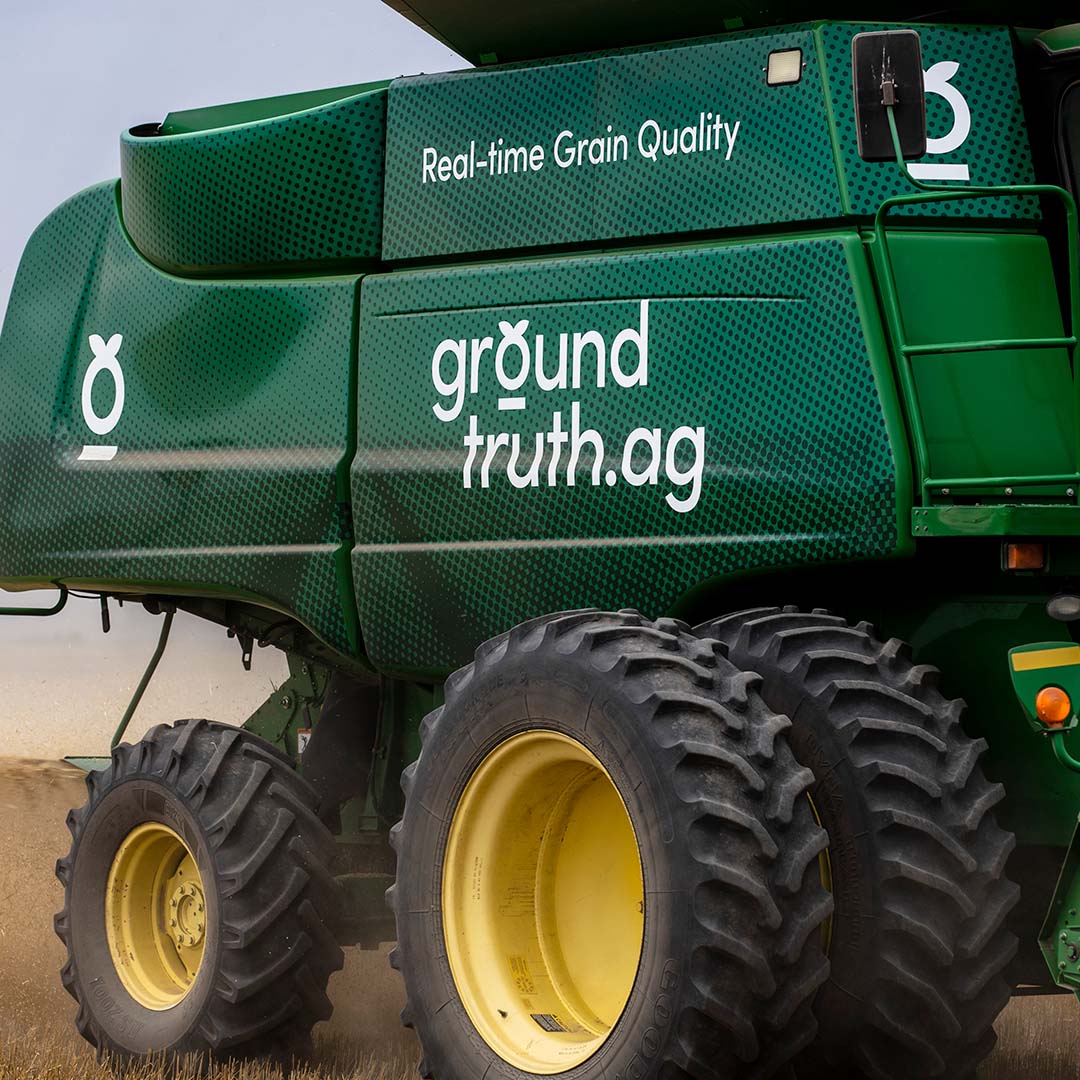
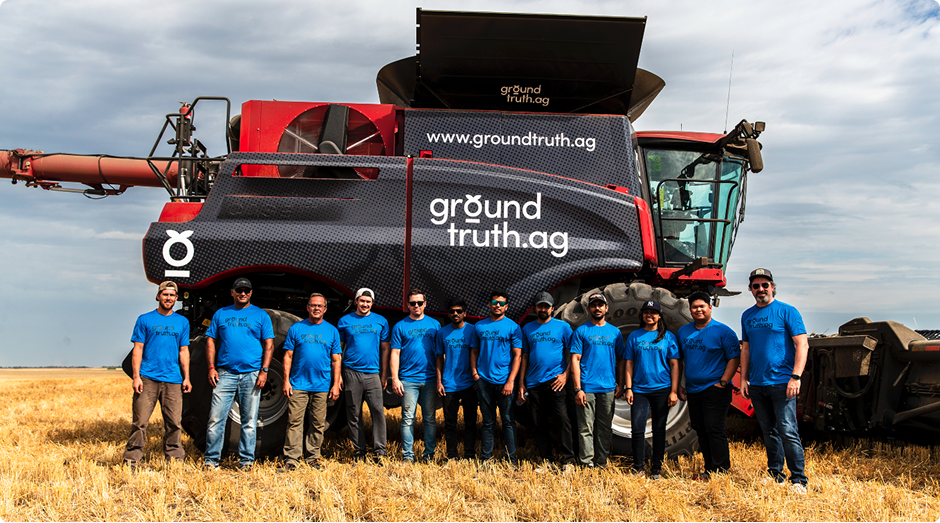
The launch itself was pure field work. Two full combines wrapped in Ground Truth's new identity, rolling at harvest while drones captured the earliest on-combine prototype in action. Not a demo in a conference hall. Not a render on a pitch deck. Real equipment, real grain, real harvest, innovating in the open where farmers could see it with their own eyes. That's the kind of moment that earns attention you can't buy.
/Ground%20Truth%20Agriculture/unoptimized/image%2011.png)
From startup to world stage
The identity and launch strategy did what it was designed to do. Ground Truth stepped onto the scene with the kind of polish and professionalism that a company at that stage rarely achieves, and the market responded. The brand gave them a foundation that held through every phase that followed: scaling from two founders to a team of 35+, tripling their office space, raising significant venture capital, and bringing a commercial benchtop grading system to market.
What made the positioning work was that it never had to be reinvented as the company grew. The same identity that turned heads at a Saskatchewan harvest carried into a venture capital pitch in Toronto, onto an accelerator stage in Topeka where Cargill and their founding partners selected Ground Truth from a global field, and across the Atlantic to AGRITECHNICA in Germany, where the company generated excitement at the world's largest agricultural machinery exhibition. The brand scaled because it was grounded in a truth that didn't change: grain grading had been broken for a century, and this team was the one fixing it.
What made the positioning work was that it never had to be reinvented as the company grew. The same identity that turned heads at a Saskatchewan harvest carried into a venture capital pitch in Toronto, onto an accelerator stage in Topeka where Cargill and their founding partners selected Ground Truth from a global field, and across the Atlantic to AGRITECHNICA in Germany, where the company generated excitement at the world's largest agricultural machinery exhibition. The brand scaled because it was grounded in a truth that didn't change: grain grading had been broken for a century, and this team was the one fixing it.
/Ground%20Truth%20Agriculture/unoptimized/ground-truth-booth.png)
/Ground%20Truth%20Agriculture/unoptimized/GTAg-Landing-Web%201.png)
They built an incredible product. We made their customers look.
$4.75+ million raised across pre-seed and seed rounds. A $4.5 million partnership with Protein Industries Canada. A commercial product in market. Selection for the Plug and Play accelerator by Cargill. International recognition at AGRITECHNICA. Coverage from CTV, RealAgriculture, BetaKit, Innovation Saskatchewan, and more. From the Canadian prairies to the world stage.
/Global%20Ag%20Risk%20Solutions/Optimized/global-ag-risk-solutions-case-study-hero.webp?width=800)